Showing posts with label Matt Owens. Show all posts

Saturday, September 17, 2016

Third time, three aquaria in two years...

If you want a planted tank, in an attempt to create a natural environment in your aquarium, you will encounter an argument in the hobby about whether or not to do a hi-tech tank, with intense lighting and CO2 injection. I don't believe there is an argument in reality, it's all a matter of what you like, and what trade-offs you like.

A "natural" aquarium is an aquarium proper

To make it simple: in a natural tank, you will be limited to "easy" plants, that are not too fussy about low levels of CO2 uptake, and also emergent plants are good, because they can take up CO2 from the air (and produce Oxygen under water). In a hi-tech tank with CO2-injection, you can achieve a greater variety of plants, including species that require more intense lighting, and those which need the extra CO2, because otherwise they would be out-competed by other plants.

When I grew up, I had the books of Dutch authors Heijmans and Thijsse, which advocated aquaria as a way to study the life in your local waters on a smaller scale, and the emphasis was very much "ecological" in nature: understanding the natural system, and the interactions of plants and fish, and all other water critters. There is a site inspired by this tradition, The Egological Aquarium.

Since I've been living in the US, I was always amazed to hear this referred to as the Dutch Aquarium, but in a further, more cultured evolution, it has also been popularized as simply the natural aquarium, and one of the big names is the Japanese Aquarist Takashi Amano. And there have been interesting contributions from Germany, including by a company called Dupla, and these days from Dennerle. These days Diana Walstad and Matt Owens are the proponents of this more natural way of keeping an aquarium, in which re-creating a natural balance on a small scale is the central focus.

Even Diana Walstad, who currently is one of the leading proponents of natural aquariums in the US, is not against "tech" per se, but her preference is trying to establish a balance between plants and fish with minimal help. She will however use an internal filter for water flow, and strongly recommends UV sterilization - which in my view isn't "not natural" because in nature waters are getting UV irradiation from the sun. She evidently does not like the high-lighting and CO2 injection, which in my view could be argued the same way to be as natural as anything else about an aquarium. In short, it's all in the eyes of the beholder.
What does matter is the distinction: between a fish tank and an aquarium.

  • A fish tank is a tank with water for the purpose of displaying fish, and usually kept under control by artificial means, without regard to the natural environment, including chemical filtration, etc. Mostly, that's what the pet stores cater to these days.
  • An aquarium proper is an effort to recreate a "natural" environment on a small scale. Studying the ecological processes becomes the central focus, including the interactions between plants and fish, filtration (mostly mechanical and biological, not chemical), lighting, CO2, UV. The focus becomes on life processes, water parameters, and the food chain. It can be "low tech," but not necessarily, it will seek to approximate natural conditions, and strive for biological balance.

The Walstad Method

For some documentation on the Walstad method, begin with her book: Diana Walstad - The Ecology of the Planted Aquarium

Next, listen to these interviews with Diana:
Next, here is even more about the Walstad Method
Beyond that, it's all about common sense and observation.

Matt Owens and the food chain

Matt Owens in his book An alternative aquarium: A robust habitat focuses as much on the overall ecological equilibrium between plants and fish, but adds a strong focus on the food chain, and recommends that you start your own refugium to in effect breed live food for your main aquariums.

Two years on: Third Time Aquarist has Three Aquaiums

Between all this reading, since I restarted my hobby two years ago with a single 5 gallon tank with a betta, and since then it has grown into a collection of three aquariums:

  • My original 5 gallon Aqueon Cue, since all pimped out with better lighting, and a ATI sponge filter. Now it serves as a refugium to grow inverts for food in my main tank, many are barely visible, but the tubifex come out in droves when you feed them wilted lettuce (that's also the way to catch them), and the scuds (gammarus) are very observable. Here are the species included:
    • Tubifex (note that by being in a refugium without fish, they cannot carry fish pathogens)
    • Gammarus
    • Copepods 
    • Daphnia
    • Planaria
    • Rotifers
    • Ostracods
  • My main. 29 gallon tank
  • And a 10 gallon shrimp tank, which also houses other inverts.
Here are some recent pictures:

5 Gallon Aqueon Cue - invert refugium, with Dracaena

10G Shrimp tank with Dracaena growing out


10 G Shrimp tank with Dracaena
Main tank, 29G, neons, rasboras, aneas cories, pygmy cories, otocinclus, amanos, MTS 


Wednesday, May 11, 2016

New Tank experiment - Ten Gallon Setup

Ok, this is going to be my third third-time aquarium, a little Aqueon 10 gallon tank, complete with the hood, that one of my neighbors threw out. I saw they got it at Christmas, for they threw out the box it came in, but by April they must have succeeded in killing all the fish, and they threw it out, so I picked it up, for I wanted to experiment with a different setup, and I believe that 10 gallon is actually the minimum acceptable tank size for a Betta, and after all, this whole experiment was kicked off by a betta fish that came home with me from a dinner two years ago, and he's still doing... swimmingly.

Tank preparation

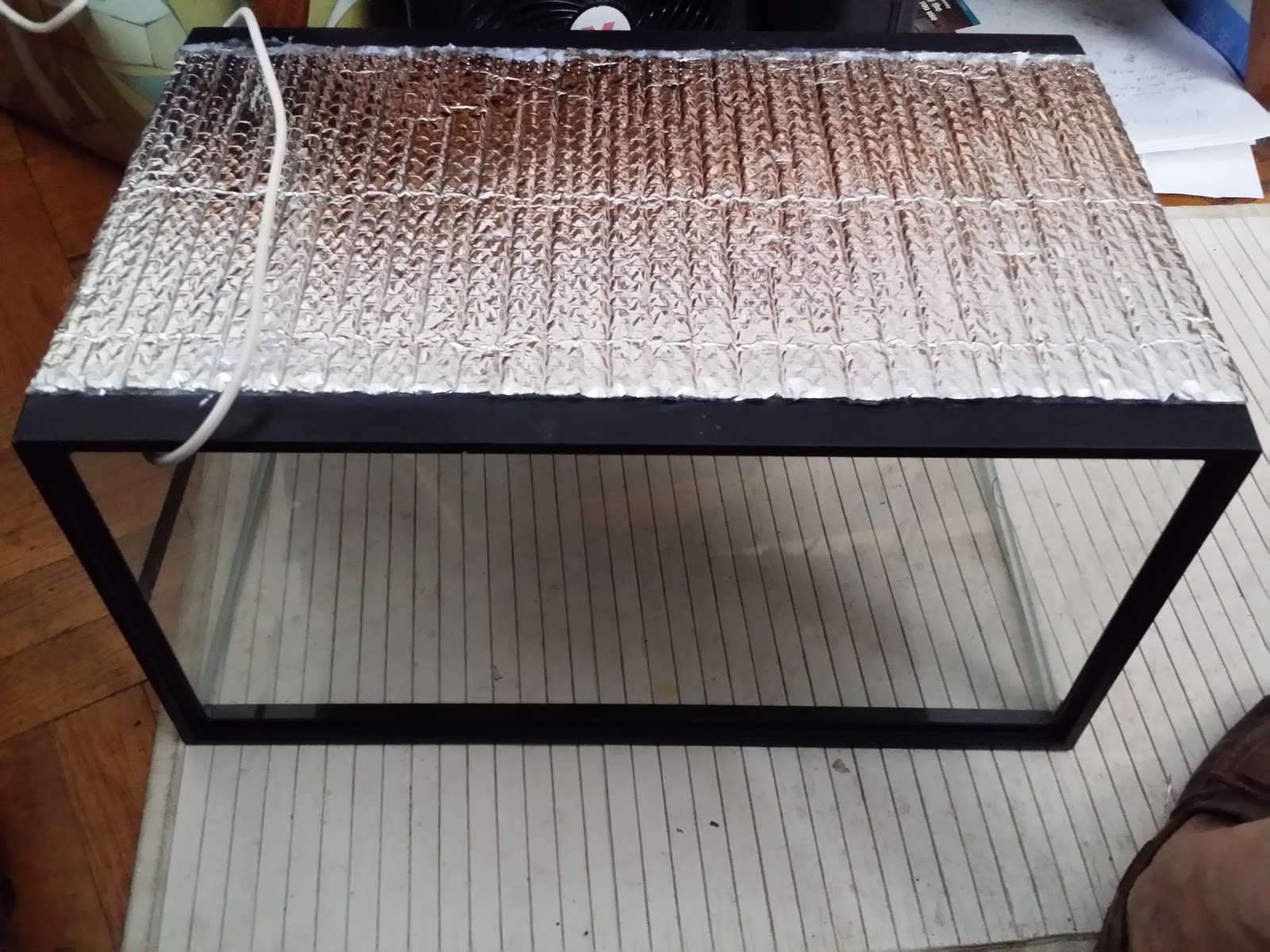
The thermal insulation backing
Looking down, heating cable installed, and back wall decoration

Frontal view, showing Hydrokable, and the back wall


New Tank Setup in Steps

Here is the program I am following, again, based on earlier experience, and now following the book by Matt Owens, The Alternative Aquarium, A Robust Habitat. In my 29G setup I had just begun reading this book and then I did an experiment with some potting soil for a Wisteria I planted in a terracotta flower pot. The plant is doing spectacularly well. So this time out, I will follow Owens' program even further and use organic potting soil for the first layer of substrate, with sand on top.

  1. Cleaning/desinfecting the tank.
  2. Installing the thermal back wall and a background.
  3. Installing Hydor Hydrokable 25W under gravel heating cable, and backup heater - 25W is not enough by itself, for it can get cold at night in winter.
  4. Add 1" water and Prodibio Bacter kit Soil, to seed the beneficial bacteria.
  5. About 1- 1.5" of organic potting soil, with all the course matter removed, such as pieces of twigs that are not fully decomposed etc. Actually, I am going to use some Aquadert in front half, and the organic potting soil in the back, for no other reason than that I had some Aquadert left over from my 29G tank installation - and, the taller, deeper rooted plants go in the back.
  6. About 1.5"of sand. I'll use Onyx Sand, with a top layer of Flourite Sand.
  7. Water fill up. Use ZeroWater, below 6 TDS, plus Seachem Replenish, to add the necessary healthy electrolytes.
  8. Tweaking GH & KH, including using AAP Wonder Shell, and Seachem Acid & Alkaline Buffer.
  9. Filtration: at first my SuperClean 5-20 moves over, to be replaced later by an ATI Sponge Filter #1. 
  10. Lighting, using the Aqueon hood, but add the Marineland 17" Hidden LED in front.
  11. Plants.
  12. Snails (MTS), and other inverts.
  13. Fish (Betta and probably a few cories, or some shrimp). Fish won't go in until the invert cultures are thriving, and the cycling of the tank is well under way.

Notes and Updates

I will make notes and updates and any comments as I go through this process. As I am writing this, I am awaiting the arrival of the Prodibio Bacter Kit Soil. Some plants will be imported from the other tanks and also help starting the bacteria, and by running the filter on here that also came from a long established tank, the cycling should go easy. Eventually, I will replace the filter with a Sponge filter, for the SuperClean would suck up too many of the invertebrates. I don't think I'll need that high of a flow rate. Particularly since I now have Duck Weed and Hornwort in all my tanks, nitrates and phosphates are less of a problem than they once were.

Saturday, February 6, 2016

My first aquarium III

My third first aquarium happened after I was at a dinner some eighteen months ago, and there was a vase with a betta on every table with instructions that someone should adopt the fish. My girlfriend knew I used to have aquariums, and challenged me to take the fish home. Resistance was futile. So, the next day, in mid-September of 2014, it was off to my local pet store, where I acquired a Aqueon Cue5, a 5-gallon "nano" tank - a little setup that was complete with aquarium, LED light, and filter, and the heater was the only thing I added. The first heater was no good, and I found that the pet store underestimated the amount of heat I needed, for temperature swings in my old-line NYC apartment can go from 55 at night to highs of 75 by day in winter, and a small heater would not do the trick, so in the end I settled for a 50W heater, and that can handle the load.

I added some gravel and some plants, and of course I got some food, and there I was, establishing a serious home for my betta friend... I even got a name for him MJF, My Jesus Fish, in honor of Mike Lemieux' book Hey Dude, Where's My Jesus Fish. Unfortunately, it was not to be, and in what was possibly a case of new tank syndrome, about two weeks later there were some symptoms that no one could explain, and within about two days, Mr. MJF was no more. I gave it some time, but I ended up getting a Mr. MJF II, who looked exactly like the first one and has now been with me for one and a half years already.


The picture on the left was Mr. MJF II about a year ago, at a time when I had my initial gravel substrate. The picture on the right is him in the hunting position, after I switched to Fluval Stratum for a substrate, and had allowed tubifex to become established in the tank, and he loves hunting those worms. By that time I also had a dark background of a picture of some aquarium plants.

Equipment

In short, it has become an ongoing experiment, in very short order after I got the tank I added CO2 injection, using both the Nutrafin Natural Plant system, which generates CO2 by fermentation, and is pretty nifty for a small tank like this, but during the day I also supplement the CO2 usually with one shot in the AM from my Fluval Mini Pressurized 20g CO2 kit. The logic of CO2 really is that you need it by day and not really by night, because at night the plants produce CO2, so the fermentation system provides the base load, and the manual operation of the pressurized CO2 provides some "peak load" during daylight time.

Pretty soon after I set up this tank initially, I did not like the little filter, and replaced the small Aqueon Quietflow filter that came with it with an API Superclean 5-20, which can be throttled down to the flow rate you want. It is an excellent filter, very flexible, and I've had excellent experience with it. I added a Fluval Edge sponge to it in order to prevent too many inverts to get sucked into the filter, or even small snails (I have an MTS population).

With my preference for plants I was not satisfied with the original light either, and for a while I added some extra lighting at midday by means of a Deep Blue Solarflare Micro 3 Watt LED, which is excellent for that purpose. However after about a year the LEDs on the original light began failing, and I went shopping for a better light. I found one that I absolutely love, the Nemolight Aquafresh 18 Watt light, which has a built-in timer function and the option to run a night light, which I do. This light could possibly handle up to a 20 gallon tank, so I run the day cycle at about half capacity, but that works like a charm, and I no longer need to run the Solarflare for extra lighting. It has to be the best aquarium light I have ever owned.

Plants and substrate

Now you wonder, is all that worth it? Well, to give you one example, out of my little tank I've been donating about one plant a month back to the aquarium store, that's how well my plants are doing, which means that there's always one that's outgrowing the tank, and that's the one I donate to the store, but then after that, I can trim as I please and mold the plants to fit the tank. So it is a living environment with a whole variety of plant growth. The plants are doing much better after removing the original gravel, and switching to Fluval Stratum substrate. For a while the micro swords had some problem staying anchored, but after a month or two of continuous replanting, their root system is growing strong enough they no longer get uprooted, not even by the Malaysian Trumpet Snails (MTS) burrowing in the substrate. For a while the betta was uprooting them also by trying to wiggle through the plants... but even that problem disappeared after the roots started to grow in. I do use some plant nutrition, both Seachem Flourish tabs, and after water changes some API leafzone.

The upshot

I guess, this is the third time for me to get into the fish hobby, hence the name of this blog, more about the second and first time later. Increasingly, I realize plants were always as important as fish in my book, but this time around I am going even further, for I became more interested in an ecological aquarium, and especially after reading Matt Owens' book: An Alternative Aquarium: A Robust Habitat, I became newly inspired to go in an ecologically balanced direction, and for one thing I introduced inverts, and for now in lieu of a refugium I have a 5 gallon pail with lucky bamboo and the original gravel, and from that the tank is getting live food about once a week or so, and some tubifex definitely are staying in the tank. I did not follow Matt's advice to collect my own inverts, but I bought them from a company called Niles Biological. For now, I have Tubifex, Rotifers, Copepods, Planaria, Gammarus, and Daphnia.- the Malaysian Trumpet Snails I inherited from the pet store with some plants. Net, net, I rarely have any algae issues, so that is working fine. And some live food will definitely help the health of the occupants.
The trouble began in earnest when an old friend from Connecticut called me a few months ago and mentioned a friend of his, whose son was moving out and left a 29 gallon tank with a stand behind. Did I want it? To be continued...